



Nature et progrès
Nature et progrès

For ten years, from 2014 to 2024, Domaine Les Opies was a member of the Nature & Progrès federation. Today, some organic certifications raise questions in the olive oil industry, particularly when commercial interests appear to conflict with environmental commitments. The Nature et Progrès Federation, a pioneer of organic farming and a leading advocate of natural agriculture, takes a fundamentally different approach. Nature et Progrès olive oil is, above all, naturally produced olive oil.
The financial interests of certification bodies, which may influence their independence, can create uncertainty among olive oil consumers. What guarantees do organic certifications really provide regarding olive oil quality? Who guarantees what? Could conflicts of interest arise between producers and certification bodies? Unfortunately, such questions can cast doubt on the entire organic sector, including producers who are genuinely committed to the quality and integrity of their products.
Nature & Progrès: A Commitment to Quality
Far more than a label or certification scheme, Nature et Progrès is a federation of associations dedicated to developing organic agriculture while respecting all living things. Its philosophy places people within nature rather than apart from it. Given the confusion surrounding organic farming in today’s economy, perhaps “natural agriculture” would be a more accurate description of the Nature et Progrès approach.
What Is the Difference Between Nature et Progrès Olive Oil and Certified Organic Olive Oil?
Paradoxically, producers affiliated with Nature et Progrès are not entitled to market their products as officially certified organic unless they also hold the relevant organic certification. This was one of the reasons we left the federation in 2024. It is worth remembering that Nature et Progrès helped pioneer and develop the concept of organic farming in the 1950s. Yet public authorities, influenced in our view by the agri-food industry, established a regulatory framework under which only officially certified producers could use protected organic designations.
Rather than relying on an independent certification body, Nature et Progrès chose to manage its quality designation collectively through a Participatory Guarantee System (PGS). In our opinion, this is also one of its main weaknesses: the possibility of a conflict of interest cannot be entirely ruled out when someone inspecting a fellow producer may later be inspected by that same person.
Through its charter and production standards, Nature et Progrès seeks to uphold agricultural and processing practices consistent with the principles of organic farming as defined by IFOAM – Organics International.
Key Criteria for Comparison
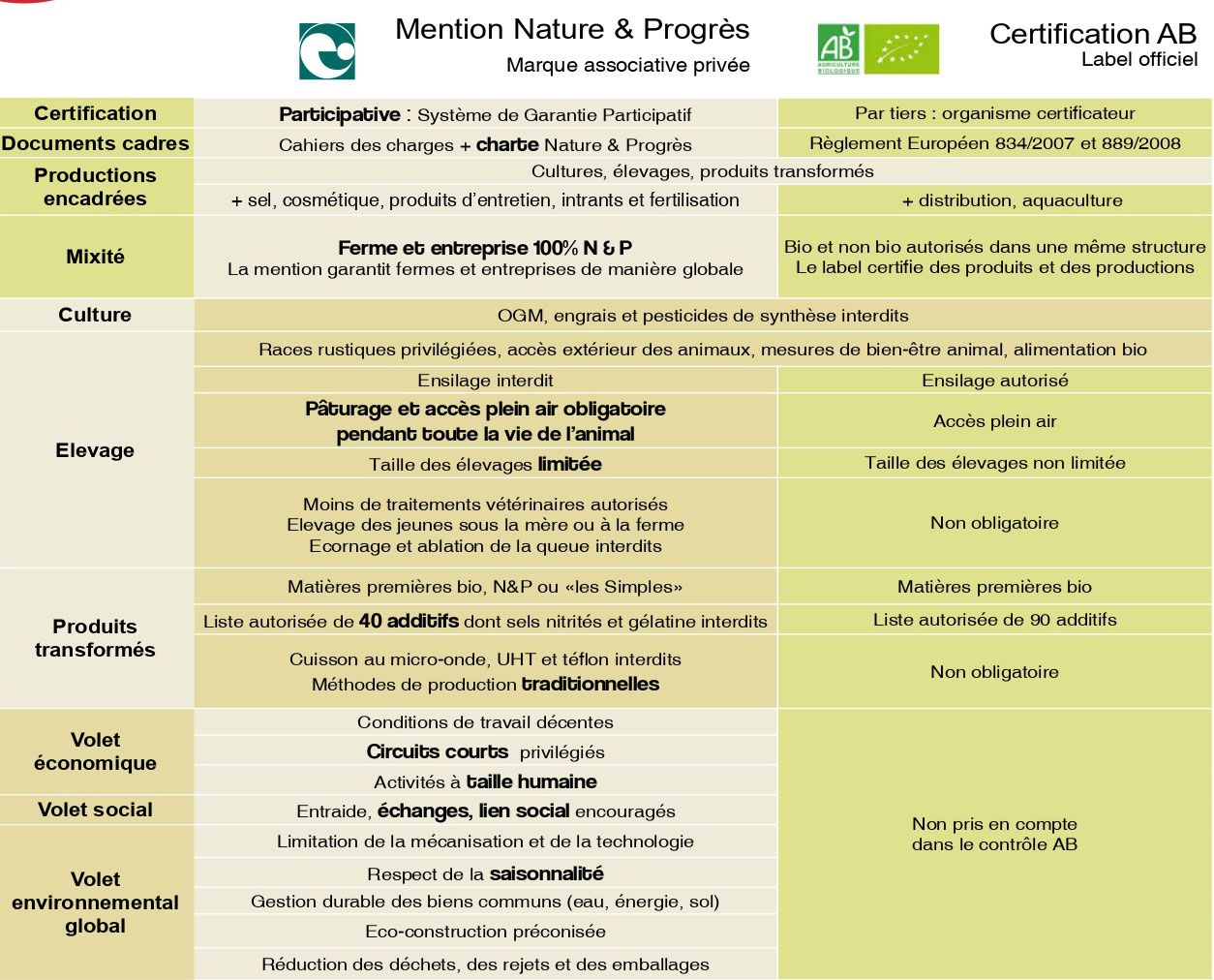
Nature et Progrès and the French AB organic label both relate to organic agriculture and food production, but their approaches differ. Nature et Progrès is an association promoting organic farming and environmentally responsible practices, while the AB label forms part of France’s official organic certification framework, based on European Union regulations.
- Certification: Nature et Progrès uses a participatory certification system. Inspections are carried out annually by members, either on a voluntary basis or through a selection process. Official organic certification, by contrast, involves an independent third-party certification body.
- Standards and governing documents: Nature et Progrès relies on its production specifications and charter. The French AB certification framework was historically governed by European Regulations 834/2007 and 889/2008, which have since been superseded by newer EU organic regulations.
- Scope: Both systems cover crop production, livestock farming and processed products. Nature et Progrès also extends its standards to cosmetics and household cleaning products.
- Mixed production: The Nature et Progrès designation applies to the entire farm, whereas official organic certification can apply to specific production activities. An olive estate producing both organic and non-organic olive oils would therefore not qualify for the Nature et Progrès designation under the approach described here, while mixed production may be permitted under official organic certification, subject to the applicable rules.
- Farming practices: Both systems prohibit genetically modified organisms and synthetic fertilisers and pesticides. Nature et Progrès olive estates must also be located at least 500 metres from major roads, according to the standards described by the federation.
- Economic, social and environmental commitments: One of the strengths of the Nature et Progrès charter is its broader approach to sustainability. Beyond agricultural production standards, it addresses working conditions, supports small-scale businesses and short supply chains, promotes eco-friendly construction, encourages responsible management of shared resources such as water, energy and soil, and seeks to reduce waste. Mutual support and social connections are also central to its philosophy.
Transparency for Olive Oil Consumers
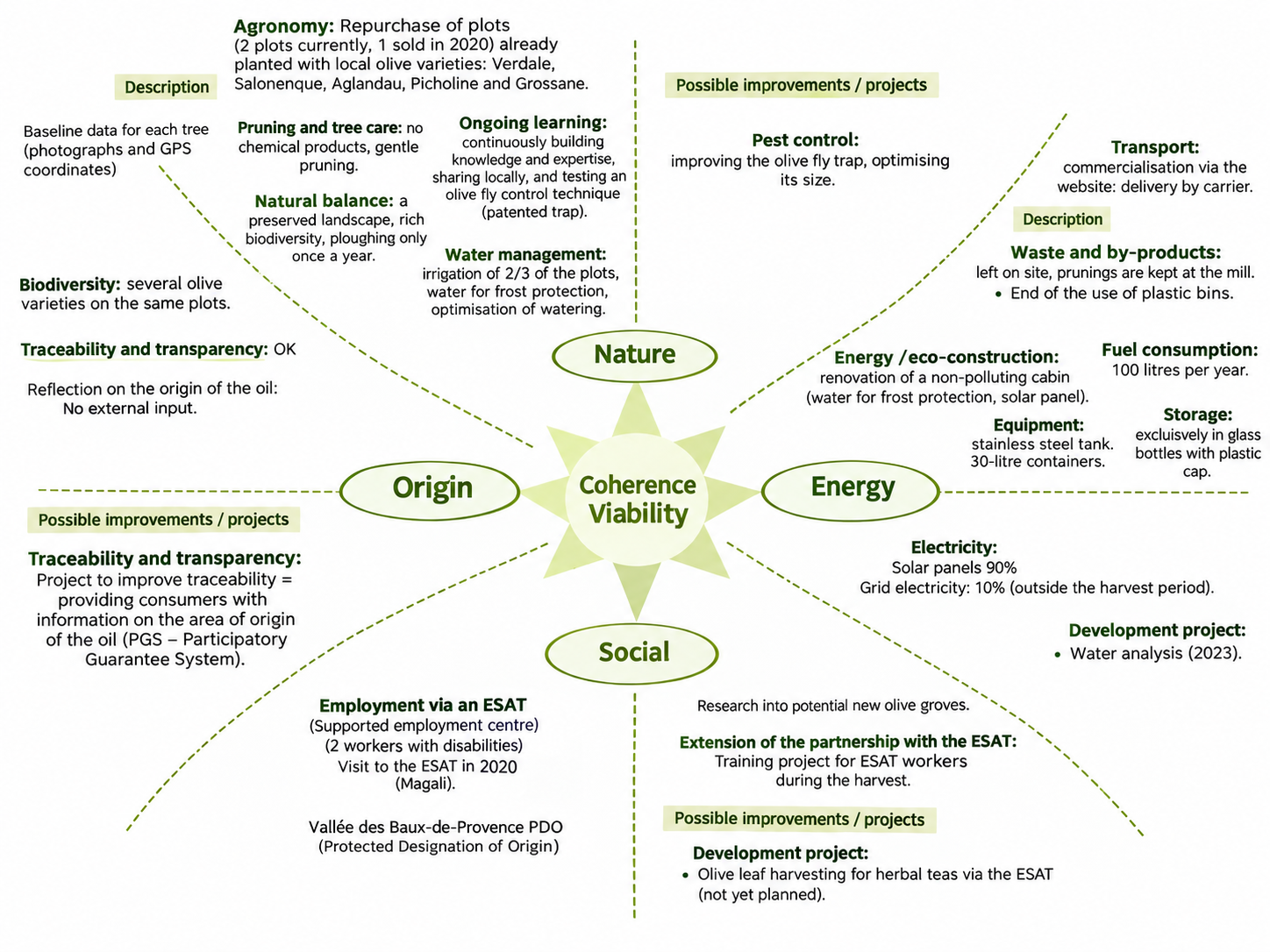
The NESO Compass is a tool designed to promote transparency between producers and consumers, helping to build relationships based on trust. It assesses how consistently producers put their commitments into practice and encourages continuous improvement. It reflects the values of responsibility and solidarity through four key principles underpinning the Nature et Progrès charter:
- Nature: Respect for the environment, animals and natural ecosystems.
- Energy: Promotion of eco-friendly construction techniques and renewable energy, alongside efforts to prevent the waste of natural resources.
- Social: Solidarity and cooperation among producers and craftspeople.
- Origin: Small-scale economic activity, knowledge sharing, short supply chains, independence and transparency towards consumers.
Domaine Les Opies’ NESO Compass in 2024
Goodbye, but Not Farewell
A great deal was achieved over those ten years. As we left the federation, we could look back with pride on the work accomplished and express our gratitude to everyone we met and shared part of our journey with.
Nevertheless, we should not ignore the challenges facing Nature et Progrès. In our view, the federation suffers from several structural weaknesses that may even threaten its long-term future. Somewhat inward-looking, it struggles to communicate its values to the wider public. The participation requirements imposed on members ultimately tipped the balance of advantages and disadvantages in the wrong direction for us.
The decisive factor behind our departure was the obligation for every member to inspect another member’s farm once a year. We do not see ourselves as inspectors, nor do we believe this is a responsibility we could fulfil properly.
Indeed, during our ten years with Nature et Progrès, we never really felt that our own estate had been inspected as thoroughly as it should have been. Most of the people who inspected us were individuals of tremendous personal integrity and experience, but they were no more professional inspectors than we were.
We believe that a meaningful inspection cannot be carried out effectively by someone without the appropriate training. Making such inspections compulsory can be counterproductive: it creates the risk of inadequate assessments, even though the credibility of the designation depends largely on the quality of its inspections.
A system based on voluntary participation, proper training and meaningful incentives could improve inspection standards and strengthen the legitimacy of the Nature et Progrès designation.
Another reason for our departure was the federation’s very limited public recognition. Although Nature et Progrès enjoys an excellent reputation among those familiar with it, its name and logo remain little known, or entirely unknown, to many consumers and distributors of organic products. This is particularly surprising within the relatively small world of agroecology, where one might expect such an organisation to be widely recognised.
After all, when producers join a certification scheme and pay for membership, one of the main benefits they expect is the credibility and visibility associated with its name.
Could Natural Agriculture Become a Recognised Alternative?
In our view, modern organic farming increasingly reflects some of the same priorities as conventional agriculture and is moving dangerously close to industrial-scale food production. Intensive farming and productivity-driven methods, focused primarily on maximising profits, are becoming more widespread.
A significant proportion of organic crops is now grown by large specialised agricultural businesses producing goods mainly for export. We fear that, in the years ahead, the French AB label may lose much of its meaning, both in the olive oil sector and beyond.
Against this background, a growing number of Nature et Progrès members, ourselves included, have considered moving away from the debate over the term “organic farming” and instead promoting the concept of Natural Agriculture.
We believe this clearer and more transparent designation could:
- Distinguish genuinely natural farming practices from forms of organic agriculture increasingly influenced by industrial-scale production.
- Clearly and legally identify farms that do not use chemical treatments, including substances of natural origin.


0 Comment